
Agnimitra Dasgupta
Agnimitra Dasgupta
Postdoctoral Research Associate
University of Southern California
Postdoctoral Research Associate
University of Southern California
2023 - PRESENT
I am the John von Neumann Fellow at the Optimization and Uncertainty Quantification Department, Sandia National Laboratories. Previously, I was a postdoctoral researcher in the Aerospace and Mechanical Engineering Department at the University of Southern California (USC), working with Professor Assad Oberai. My research sits at the interface of probabilistic modeling, machine learning, computational mechanics, and scientific computing. I combine generative models with physics knowledge to develop scalable and efficient frameworks for probabilistic inference and rare-events simulation.
I obtained my PhD in Civil Engineering at USC under the supervision of Professor Erik Johnson. I was awarded the USC Provost’s Ph.D. Fellowship between 2017-2021. During my PhD, I spent three summers as an intern at the Mathematics and Computer Science Division in the Argonne National Laboratory, where Zichao 'Wendy' Di was my mentor. Before USC, I received my Bachelor's and Master's Degrees in Civil Engineering from Jadavpur University and the Indian Institute of Science, respectively. I also have a Master's in Electrical Engineering from USC.
I am the John von Neumann Fellow at the Optimization and Uncertainty Quantification Department, Sandia National Laboratories. Previously, I was a postdoctoral researcher in the Aerospace and Mechanical Engineering Department at the University of Southern California (USC), working with Professor Assad Oberai. My research sits at the interface of probabilistic modeling, machine learning, computational mechanics, and scientific computing. I combine generative models with physics knowledge to develop scalable and efficient frameworks for probabilistic inference and rare-events simulation.
I obtained my PhD in Civil Engineering at USC under the supervision of Professor Erik Johnson. I was awarded the USC Provost’s Ph.D. Fellowship between 2017-2021. During my PhD, I spent three summers as an intern at the Mathematics and Computer Science Division in the Argonne National Laboratory, where Zichao 'Wendy' Di was my mentor. Before USC, I received my Bachelor's and Master's Degrees in Civil Engineering from Jadavpur University and the Indian Institute of Science, respectively. I also have a Master's in Electrical Engineering from USC.
I am the John von Neumann Fellow at the Optimization and Uncertainty Quantification Department, Sandia National Laboratories. Previously, I was a postdoctoral researcher in the Aerospace and Mechanical Engineering Department at the University of Southern California (USC), working with Professor Assad Oberai. My research sits at the interface of probabilistic modeling, machine learning, computational mechanics, and scientific computing. I combine generative models with physics knowledge to develop scalable and efficient frameworks for probabilistic inference and rare-events simulation.
I obtained my PhD in Civil Engineering at USC under the supervision of Professor Erik Johnson. I was awarded the USC Provost’s Ph.D. Fellowship between 2017-2021. During my PhD, I spent three summers as an intern at the Mathematics and Computer Science Division in the Argonne National Laboratory, where Zichao 'Wendy' Di was my mentor. Before USC, I received my Bachelor's and Master's Degrees in Civil Engineering from Jadavpur University and the Indian Institute of Science, respectively. I also have a Master's in Electrical Engineering from USC.
I AM ON THE ACADEMIC JOB MARKET
I AM ON THE ACADEMIC JOB MARKET
Research Interests
Scientific machine learning
Generative modeling
Probabilistic modeling & inference
Computational mechanics
Education
2023
Ph. D. in Civil Engineering
University of Southern California, Los Angeles, USA
2020
Master of Science in Electrical Engineering
University of Southern California, Los Angeles, USA
2017
Master of Engineering in Civil Engineering
Indian Institute of Science, Bangalore, India
2015
Bachelor of Engineering in Civil Engineering
Jadavpur University, Kolkata, India
Updates
[September '24] I delivered a seminar on Solving physics-constrained inverse problems using conditional diffusion models at USC's Aerospace and Mechanical Engineering Department.
[September '24] I delivered a seminar on Solving physics-constrained inverse problems using conditional diffusion models at USC's Aerospace and Mechanical Engineering Department.
[August '24] I gave a talk on Solving inverse problems in mechanics using conditional score-based diffusion models at USACM's UQ-MLIP workshop. Thanks to all the organizers!
[August '24] I gave a talk on Solving inverse problems in mechanics using conditional score-based diffusion models at USACM's UQ-MLIP workshop. Thanks to all the organizers!
[May '24] I organized a mini-symposium on Probabilistic, Physics-guided, and Multi-fidelity generative modeling for Uncertainty Quantification at the ASCE Engineering Mechanics Institute Conference.
[May '24] I organized a mini-symposium on Probabilistic, Physics-guided, and Multi-fidelity generative modeling for Uncertainty Quantification at the ASCE Engineering Mechanics Institute Conference.
[Feb '24] I gave a talk on Uncertainty quantification using generative models at the Coordinate Sciences Laboratory, University of Illinois, Urbana-Champaign. Thank you for inviting me, Prashant.
[Feb '24] I gave a talk on Uncertainty quantification using generative models at the Coordinate Sciences Laboratory, University of Illinois, Urbana-Champaign. Thank you for inviting me, Prashant.
Selected Research
Bayesian inference with conditional score-based diffusion models
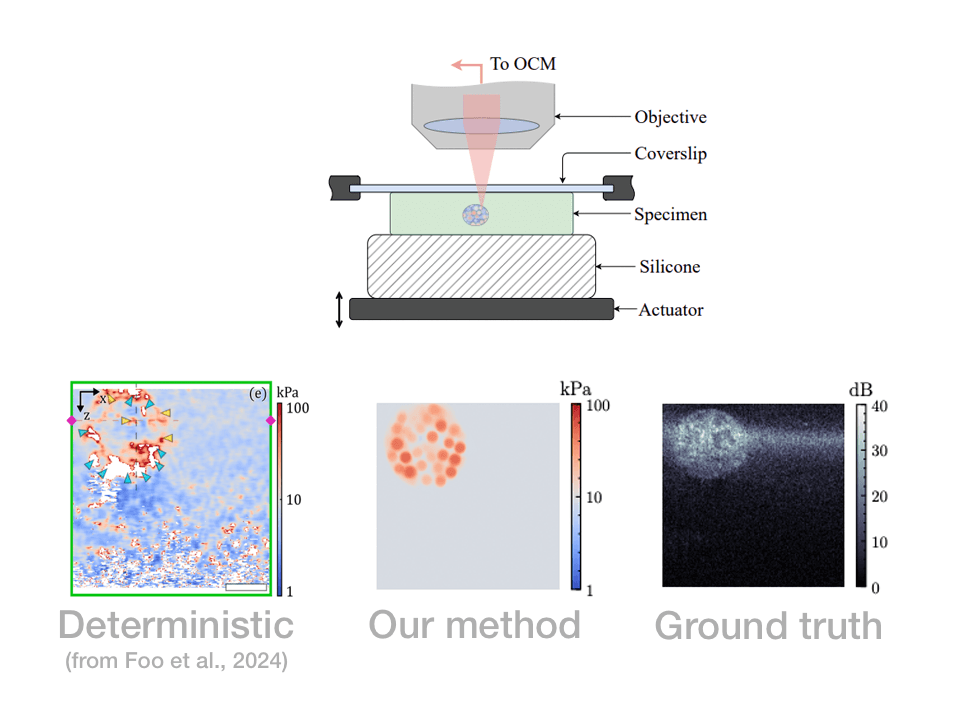
We propose conditional score-based diffusion models for large-scale Bayesian inference. The method is simulation-based, likelihood-free, and amortized. In a notable application, we recover tumor spheroids's elastic modulus from laboratory optical coherece elastography experiments, and quantify uncertainties while doing it. The inverse problem has more than 25,000 variables that must be inferred!

Bayesian inference with conditional score-based diffusion models
We propose conditional score-based diffusion models for large-scale Bayesian inference. The method is simulation-based, likelihood-free, and amortized. In a notable application, we recover tumor spheroids's elastic modulus from laboratory optical coherece elastography experiments, and quantify uncertainties while doing it. The inverse problem has more than 25,000 variables that must be inferred!